Among the many conversations I have had with Great Books students over the years, none is more lively than when we discuss various theories of truth. It seems to always come up when we are reading and talking about Thomas Aquinas's Summa. In order to make immediate connection with them, I tell the story about three umpires in a bar after a game. These officials are discussing what really happens when they call balls and strikes. What they are really doing is discussing the relationship between reality and human apprehension of said reality.
The umpires are discussing the relationship between the pitching of the ball and the calling of said pitch by the umpire. It goes like this:
1) When it comes to making calls behind the home plate, I call it the way it is....
2) When it comes to making calls behind home plate, I call it the way I see it....
3) When it comes to making calls behind home plate, it ain't nothing until I call it....
Those of us who have played or enjoyed the game of baseball get the import of this conversation. The truth is that it is easy to hear what each is saying and recognize the legitimacy of their respective claim. Additionally, it is also realitvely easy to extrapolate from their statements and expand them to the point of seeing how wrong they are in their claim.
1) Is it possible that this umpire would ever admit to being wrong?
2) Is the reality of the ball and strike rooted in the perception of the umpire?
3) What if the pitcher threw the ball twenty feet over the catcher's head and it struck the press box and the umpire called it a strike, it would be, but he would be fired--why?
In steps Etienne Gilson and the "umpire" I would want calling the game. The recent re-publication of his short masterpiece, Methodical Realism is must reading for all baseball and softball officials, and it should be for all thinking people. If you have ever wondered about the chasm that separates most old school Humanists and most modern Social Scientists, here is the debate between the coherentists theory of truth and the correspondence theory of truth. Gilson does a spectacular job of showing that we are all correspondence theorists, but we do not all know it.
Friday, March 23, 2012
How Reading Josef Pieper Can Help You Stay Sane
It is not common that a person would recommend a Philosopher to help you stay sane, but with the writings of Josef Pieper, if you have ever read even one of his books, you are likely to agree with me. He is certainly different from other philosophers. I have a friend, Philosophy professor who wrote his dissertation on a Philosopher who penned books that usually topped several hundred pages. Pieper's books are often less than 150 pages. The truth is that he says more in less space than most say in more space. Most Philosophers I know have to throw around words like ontological, noetic, hermeneutical epistemology, and occasional neologism, fourteensyllablewordhereandthere. Pieper was not that way and for the non-technical reader, this is a joy.
Also, the range of his wisdom is most impressive. Some of the titles I have read and re-read and actually use in classes include:
In Defense of Philosophy - It is difficult to explain to people who have ever met a "professional Philosopher" that this lot has seriously perverted what real Philosophy is, and that despite their enormous vocabulary, most of them are not really Philosophers. Philosophy is the "love of wisdom." Pieper makes the case that, " ...to engage in philosophy means to reflect on the totality of things we encounter, in view of their ultimate reasons; and philosophy, thus understood, is a meaningful, even necessary endeavor, with which man, the spiritual being, cannot dispense."
The Human Wisdom Of St. Thomas - This little book is collection of select quotes from the writings of Thomas Aquinas. If you have never read St. Thomas because he can be a bit intimidating, this is a fine place to start. I have used this little book in a number of ways, including a source for deep ideas to meditate upon.
Leisure: The Basis of Culture - Despite the chaos our current economy is experiencing, this is a perfect book to better understand the problems and the solutions.
In Tune With The World: A Theory of Festivity - After you read Leisure, this is a wonderful companion book. You will never experience worship or festivals the same way.
The Concept of Sin - Not merely a reflection on sin, but an analysis of how we speak and do not speak about sin.
Death and Immortality - Among the most important books on a subject we all experience, but few think about until the very end.
Tradition - Pieper shows what Tradition is and what happens when we do not have rich traditions.
The Platonic Myths - A great book to read before or after you read the Platonic dialogues.
The Christian Idea of Man - The best example of Christian thinking about the exploration of "know Thyself."
I have never shared a Pieper book in which the person does not return it with words of gratitude. He is that author that truly can help us not lose our minds in a moment when minds seem to matter so little to so few.
Also, the range of his wisdom is most impressive. Some of the titles I have read and re-read and actually use in classes include:
In Defense of Philosophy - It is difficult to explain to people who have ever met a "professional Philosopher" that this lot has seriously perverted what real Philosophy is, and that despite their enormous vocabulary, most of them are not really Philosophers. Philosophy is the "love of wisdom." Pieper makes the case that, " ...to engage in philosophy means to reflect on the totality of things we encounter, in view of their ultimate reasons; and philosophy, thus understood, is a meaningful, even necessary endeavor, with which man, the spiritual being, cannot dispense."
The Human Wisdom Of St. Thomas - This little book is collection of select quotes from the writings of Thomas Aquinas. If you have never read St. Thomas because he can be a bit intimidating, this is a fine place to start. I have used this little book in a number of ways, including a source for deep ideas to meditate upon.
Leisure: The Basis of Culture - Despite the chaos our current economy is experiencing, this is a perfect book to better understand the problems and the solutions.
In Tune With The World: A Theory of Festivity - After you read Leisure, this is a wonderful companion book. You will never experience worship or festivals the same way.
The Concept of Sin - Not merely a reflection on sin, but an analysis of how we speak and do not speak about sin.
Death and Immortality - Among the most important books on a subject we all experience, but few think about until the very end.
Tradition - Pieper shows what Tradition is and what happens when we do not have rich traditions.
The Platonic Myths - A great book to read before or after you read the Platonic dialogues.
The Christian Idea of Man - The best example of Christian thinking about the exploration of "know Thyself."
I have never shared a Pieper book in which the person does not return it with words of gratitude. He is that author that truly can help us not lose our minds in a moment when minds seem to matter so little to so few.
Saturday, March 17, 2012
Russell Kirk on T.S. Eliot's The Waste Land
In all of our Great Books based programs we exalt the primary readings, unmediated by commentaries, critical theories, jargon ladened treatises, and a mountain of secondary works explaining what a given author meant within his work. What we generally do is encourage the students to jump right in and start swimming. By asking interpretive questions and applying the Socratic method of clarifying and qualifying, the student has better understanding of the reading. Of course, we all know that sometimes answers to our questions about a reading are not to be found within the work and sometimes we need additional outside, background materials to assist a fuller reading. Typically, our students read introductions at the end and not the beginning.
All this is stated to provide the exceptions. Sometimes there are those writings about the Great Books that offer such assistance and are so rich with insight that the secondary work in conversation with the primary work comes a work well worth reading and analysis. One could immediately think of T.S. Eliot's reflections on Dante's Divine Comedy. Another would be Russell Kirk's ruminations on T.S. Eliot's The Waste Land.
T.S. Eliot's The Waste Land is a dense work, but we demonstrate to our Great Books students every spring that they understand much more of it than they think. We also tell them about Kirk's work about The Waste Land.
Without doubt, and certainly without rival, the best commentary of Eliot's The Waste Land is his Eliot's own oral interpretation of The Waste Land which is easily available online. In addition to that, I would add that one should read Russell Kirk's reflections on this masterpiece.
Here are a few quotes from Russell Kirk's The Inner Waste Land and the Outer unmediated by commentaries, critical theories, jargon ladened treatises, and a mountain of secondary works explaining what Kirk meant within his reading of Eliot.
Certain critics have offered theories about the poem so openly in conflict with Eliot's own literary principles and with his later writings that one wonders whether those commentators ever read the poem itself with the desire to understand; they have read the notes and have read earlier critics – whom they imitate or denounce. But the poem may be read appreciatively without the possession of a doctoral degree in literature; and it is no allegory, but rather after its fashion a narrative poem, as the Aeneid and The Divine Comedy are narrative and philosophical.
In short, Eliot has described in The Waste Land not merely his ephemeral state of mind; much more important, he has penetrated to causes of a common disorder in the soul of the twentieth century.
Not his private misgiving, but his concern with the condition of modern man, is what gives The Waste Land an enduring force. Before him sprawled a prospect of private and public disorder.
My own summary analysis, which follows, is an endeavor to penetrate to the heart of the poem, necessarily refraining from comment upon Eliot's technique, and avoiding most excursions into his evocation of prophets, saints, poets, potentates, and anthropologist.
The Waste Land, then, is no glorification of the Past. What the reader should find in this poem, rather, is Eliot's vices and the same virtues are at work in every age; and our present discontents, personal and public, can be comprehended only if we are able to contrast our present circumstances with the challenges and the responses of other times.
The Waste Land is the endeavor of a philosophical poet to examine the life we live, relating the timeless to the temporal. A Seeker explores the modern Waste Land, putting questions into our hands, and though the answers we obtain may not please us, he has roused us from our death–in–life.
The general meaning of The Waste Land is as clear as its particular lines are dark.
Eliot had asked the great questions; and in The Waste Land, here and there, blades of grass had begun to sprout.
I urge the reader to carefully, and slowly follow along as Eliot reads you through The Waste Land and as you need help, let Russell Kirk be your Virgil.
Without doubt, and certainly without rival, the best commentary of Eliot's The Waste Land is his Eliot's own oral interpretation of The Waste Land which is easily available online. In addition to that, I would add that one should read Russell Kirk's reflections on this masterpiece.
Here are a few quotes from Russell Kirk's The Inner Waste Land and the Outer unmediated by commentaries, critical theories, jargon ladened treatises, and a mountain of secondary works explaining what Kirk meant within his reading of Eliot.
Certain critics have offered theories about the poem so openly in conflict with Eliot's own literary principles and with his later writings that one wonders whether those commentators ever read the poem itself with the desire to understand; they have read the notes and have read earlier critics – whom they imitate or denounce. But the poem may be read appreciatively without the possession of a doctoral degree in literature; and it is no allegory, but rather after its fashion a narrative poem, as the Aeneid and The Divine Comedy are narrative and philosophical.
In short, Eliot has described in The Waste Land not merely his ephemeral state of mind; much more important, he has penetrated to causes of a common disorder in the soul of the twentieth century.
Not his private misgiving, but his concern with the condition of modern man, is what gives The Waste Land an enduring force. Before him sprawled a prospect of private and public disorder.
My own summary analysis, which follows, is an endeavor to penetrate to the heart of the poem, necessarily refraining from comment upon Eliot's technique, and avoiding most excursions into his evocation of prophets, saints, poets, potentates, and anthropologist.
The Waste Land, then, is no glorification of the Past. What the reader should find in this poem, rather, is Eliot's vices and the same virtues are at work in every age; and our present discontents, personal and public, can be comprehended only if we are able to contrast our present circumstances with the challenges and the responses of other times.
The Waste Land is the endeavor of a philosophical poet to examine the life we live, relating the timeless to the temporal. A Seeker explores the modern Waste Land, putting questions into our hands, and though the answers we obtain may not please us, he has roused us from our death–in–life.
The general meaning of The Waste Land is as clear as its particular lines are dark.
Eliot had asked the great questions; and in The Waste Land, here and there, blades of grass had begun to sprout.
I urge the reader to carefully, and slowly follow along as Eliot reads you through The Waste Land and as you need help, let Russell Kirk be your Virgil.
Friday, March 16, 2012
What Do You Get When A World Class Philosopher Reads Darwin
In my ideal university, the Philosophy Professors and Biology Professors cross enemy lines and actually converse with one another. The problem with the modern university is that it would be rare to find a Philosopher or Biologist who has actually read Darwin, that is really read Darwin. But, let's stay with this for a few minutes. So we have found a Philosopher and Biologist who are educated enough to read Darwin. Instead of talking past one another, they actually want to talk to one another. They both imagine how their respective disciplines are far from having all the answers and believe that they may learn from one another. Ok, never-mind.
Let's start over. We have found two professors who know a little about their disciplines, but deeply desire to talk across disciplines. So this Biologist and and Philosopher set a day and time to read and talk about Darwin's writings. I tried, but I cannot actually imagine any of these things happening. Fine, one last try - a few Professors at some obscure University who are life long learners and decide that it is time to read Darwin set out a reasonable plan to read and discuss....not going to happen....I give up.
Go get a copy of Aristotle's History of Animals, On Sense and Sensible, On Longevity and Shortness of Life, On Youth and Old Age, On Life and Death, On Breathing and get a copy of Darwin's The Origin of Species and The Descent of Man and Etienne Gilson's From Aristotle to Darwin and Back Again and read. Learn what the issues are and the place of final causality, species, and the meaning of evolution in the arguments that rage across the land. If you do this, then you will know more than most Philosophers and Biologists.
Thursday, March 15, 2012
The Road We've Traveled to Animal Farm
Just when we thought it could not get any worse, it does. I was hoping for that incontrovertible bit of proof that Squealer (aka Tom Hanks as narrator) was alive and well and then we hear him making his plea to give Napoleon "four more years". I had just blogged on the relationship between the current political situation in Washington and then the propaganda machine jumps into high gear.
After reading Animal Farm or watching the 1954 version free on Hulu, watch The Road We've Traveled and see if you don't agree. We are in major trouble and it is more than scary.
Monday, March 12, 2012
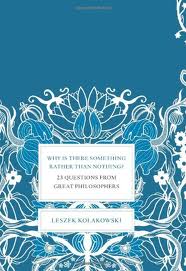
Books With Questions....Kolakowski's Why There Is Something Rather Than Nothing?
Books about questions or books that genuinely explore great questions are generally a step above most books that merely explore ideas by asserting. Leszek Kolakowski's Why Is There Something Rather Than Nothing? 23 Questions From Great Philosophers is a fine way to introduce Philosophy to someone. This book is not for a seasoned Philosopher, unless he has become so entrenched in Philosophy that he is mind numbingly boring and irrelevant.
This book is really for the person who has been given a false view of Philosophy as being unimportant or unapproachable. By taking the approach of asking questions and thinking through those questions (doing Philosophy), Kolakowski's demonstrates the ongoing value of thinking. See below just a few of the chapter titles and the Philosophers he examines.
Truth and the Good: Why Do We Do Evil? Socrates
The Good and the Just: What is the Source of Truth? Plato
Life in Accordance With Nature: Can It Make Us Happy? Epictetus
God and Man: What is Evil? St. Augustine
God's Necessity: Could God Not Exist? St. Anselm
Knowledge, Faith and the Soul: Is the World Good? St. Thomas Aquinas
Faith: Why Should We Believe? Blaise Pascal
The Foundations of Certainty: What Can We Know and How Can We Know it? Edmond Husserl
Read, Think, Enjoy, Live!
This book is really for the person who has been given a false view of Philosophy as being unimportant or unapproachable. By taking the approach of asking questions and thinking through those questions (doing Philosophy), Kolakowski's demonstrates the ongoing value of thinking. See below just a few of the chapter titles and the Philosophers he examines.
Truth and the Good: Why Do We Do Evil? Socrates
The Good and the Just: What is the Source of Truth? Plato
Life in Accordance With Nature: Can It Make Us Happy? Epictetus
God and Man: What is Evil? St. Augustine
God's Necessity: Could God Not Exist? St. Anselm
Knowledge, Faith and the Soul: Is the World Good? St. Thomas Aquinas
Faith: Why Should We Believe? Blaise Pascal
The Foundations of Certainty: What Can We Know and How Can We Know it? Edmond Husserl
Read, Think, Enjoy, Live!
Sunday, March 11, 2012
Before You Vote, Read Orwell's Animal Farm and Politics and the English Language
For Christians living in a culture such as our's, a key issue is the "grammar" and "rhetoric" of our daily lives. Imagine what would happen if we embraced the vocabulary of our faith and it became the way we talked to one another and about one another. I recently read Animal Farm and Orwell's essay Politics and the English Language, as well as Orwell's Inside the Whale. Speaking of the English language (in Politics), Orwell remarking on our language says, "it becomes ugly and inaccurate because our thoughts are foolish, but the slovenliness of our language makes it easier for us to have foolish thoughts. The point is that the process is reversible." (103)
In Orwell's essay Inside The Whale (1940), he brilliantly dissects totalitarianism. We, in America, should not be so ignorant of history or the workings of dictatorships to be so naive as to not recognize the real possibility that totalitarianism can even exist in the presence of a democratic republic. Orwell says, "almost certainly we are moving into an age of totalitarian dictatorships – an age in which freedom of thought will be at first a deadly sin and later on a meaningless abstraction. The autonomous individual is going to be stamped out of existence."
Many Americans would stand and shout that this type of oppression exists "over there" in "other parts of the world," but where freedom of conscience is squashed, one can mark the days on the calendar before other freedoms are eliminated.
One of the many advantages in reading the Great Books is that truly Great books have the ability to remove us from our present moment and take us somewhere else, expose us to different ideas, issues, and landscapes, and then return us to our own. This enables us to see our own world, and more clearly see our own moment and issues. Such a work is George Orwell's Animal Farm. Due to the recent attention to our political landscape, and what will certainly endure for the next several months, we all need a different way of seeing political debates, political advertisements, and political campaigns. Again, George Orwell's Animal Farm is of great assistance.
While I have several favorite moments, and a few favorite characters for different reasons, I will not give away too much and hope that if you have never read this work you will read it, and if you read it sometime ago, you will read it again before you vote. In the story there is a character, Old Major, who says, "Man is the only real enemy we have. Remove man from the scene, and the root cause of hunger and overwork is abolished forever."
Later the same character asks, does not "all the evils of this life of ours spring from the tyranny of human beings?" This reminds me of what happens when someone assumes the Oval Office, having promised instant improvement, but then blames the previous administration for months and even years for all the woes and evils he is facing. Adding that it will take four to eight years to correct all of these evils. All the time ignorant of the woes and evils he is creating for the next President.
Animal Farm is also an extraordinary exploration of the workings of propaganda. It is sometimes comical, but often deadly serious how characters such as Squealer (think White House press office or major network news media) will take a statement and twist and turn it and turn it and twist it to where it sounds like something very different from what is reality and from what was previously stated.
It would also be well worth your time to read Jacques Ellul's Propaganda: The Formation of Men's Attitudes--a brilliant work that explores the nature of political propaganda and the more hideous sociological propaganda. Back to Animal Farm. In a number of key places, Squealer corrects what others are saying they know to be the truth, what they have heard, what they have seen and all that has even been painted on the side of the barn. At one place in the story it says this of Squealer, "the best known among them was a small fat pig named Squealer, with very round cheeks, twinkling eyes, nimble movements and a shrill voice. He was a brilliant talker, and when he was arguing some difficult point he had a way of skipping from side to side and whisking his tail which was somehow very persuasive. The others said of Squealer that he could turn black into white."
Among the many memorable lines from Orwell's Animal Farm, no doubt the phrase "all animals are equal but some are more equal than others" is the best known. One can think of our current political and social landscape where we could say that in the United States of America all are equal, but more will be made equal by those who work, and accomplish and will be compelled to be responsible for taking care of the less equal by making the less equal the most equal.
So when you vote now or anytime in the foreseeable future, ask these questions--Will I vote for Pigs (read Orwell's Animal Farm) to be in power? Will I vote for the Grand Liars or the tiny liars? Will I vote for the Evil Perverters of Truth or the evil perverters of truth? Words for thought, while some words still mean something!
Subscribe to:
Posts (Atom)