Showing posts with label Book Reviews. Show all posts

Sunday, December 9, 2012

Visiting Donald Hall's Eagle Pond This Christmas

  For lovers of great poetry, the name Donald Hall is well known. For those familiar with the poetry of Donald Hall, we recognize the fondness Hall has for the particular place of Eagle pond. In Christmas at Eagle Pond, Hall offers all readers a treasure, in the form of a short story about an imagined childhood Christmas experience at Eagle Pond. In the midst of numerous delightful moments, there is an important reflection of a Christmas pageant and the place a Christmas party held in the life of the community. There are simple and elegant back and white illustrations throughout. The value and glory of transmission of folk culture through story telling is pushed to the front of the narrative more than once.
     The story is set in the time of model A's and T's with some still using buggies and sleighs. Among the many worthy moments in the story, there is a beautiful moment and image of prayer. Additionally, the charm of a revised version of "Casey at Bat" is fitting in light of the teller of the tale. While I've never experienced it, I participated vicariously in the process of making popcorn (long before the instantness of the microwave) in a kettle, adding syrup with the intention of making popcorn balls for decoration and eating. 
    My favorite description and one that speaks of one joy of embodiment is when the narrator says, "I walked through their icy bedroom to mine, even icier, and stuffed my hot-water bottle under the sheets to warm my feet. Crawling beneath the covers I shivered a moment, but the quilts were thick, my feet almost too hot, and soon I fell asleep in my familiar goose feather bed at the house I loved most in the world." The prose of Hall is as smooth and flowing as his poetry with some lines singing like his poetry. This is a story to be enjoyed this Christmas season and will most certainly call to mind childhood Christmas memories..

Tuesday, November 27, 2012

A Picture Book That Calls Us to Books and Living

     My wife is a librarian and daily interacts with children and books. If I were not a Professor, I cannot think of a more appealing calling. We talk daily about the little ones in her school, books, and the relationship between bookish children and their overall demeanor. A picture book that we recently became aware of is The Fantastic Flying Books of Mr. Morris Lessmore
     For all bibliovores, regardless of age, this book is for you. It is beautiful in form and content, it is good in form and content, and it is true in form and content. Rarely does one find a children's picture book that so throughly celebrates a bookish life, but also deals with some grand humane themes. In addition to this unique book, there is an app (sorry Luddites) that is interactive with the book.  For the critics of such apps, one can make the case that this app encourages greater interaction with the book and other books. For short film lovers, this wonderful book also inspired the Academy Award winning short film. 

Monday, April 23, 2012

Reading W.H. Auden's Age of Anxiety in Our Age of Angst


     Among the most quoted and likely the least read works of modern poetry is W.H. Auden's deep and insightful The Age of Anxiety.  Readers who need some help with the richness of this modern poetic masterpiece, you now can get the the first critical edition and annotated volume of Auden's The Age of Anxiety since the original publication.  Similar to Eliot's The Waste Land, this poem requires some deep attention and assistance.  Scholar Alan Jacobs introduces this important work to a new prospective generation of open readers by placing the poem within the historical and biographical context, and providing numerous references to potential obscurities.  Alan Jacobs's introduction and informed annotations help today's readers understand and appreciate the full richness of a poem that contains some of Auden's most powerful and beautiful verse, and that deserves a place among the Great Books of the Western World.
     When it was first published in 1947, The Age of Anxiety was Auden's longest, and clearly his most sweeping poem.  The work was well received among critics and intelligent readers as it was a brilliant, cultural commentary on that particular moment. Beginning as a conversation among four strangers in a barroom on New York's Third Avenue, Auden's analysis of Western culture during the Second World War won the Pulitzer Prize and inspired a symphony by Leonard Bernstein. Auden has characters (Quant, Malin, Rosetta, and Emble) engaged in a reflective  conversation exploring the contours and particulars of the age within which they were living.  Likely, if this work were cast today, it would likely take place in a Sports Bar with an array of our athletic distractions blaring in the background.  


Monday, March 12, 2012

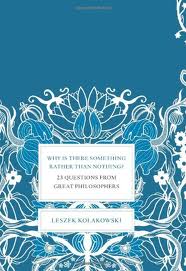
Books With Questions....Kolakowski's Why There Is Something Rather Than Nothing?

     Books about questions or books that genuinely explore great questions are generally a step above most books that merely explore ideas by asserting.  Leszek Kolakowski's Why Is There Something Rather Than Nothing? 23 Questions From Great Philosophers is a fine way to introduce Philosophy to someone.  This book is not for a seasoned Philosopher, unless he has become so entrenched in Philosophy that he is mind numbingly boring and irrelevant.  
     This book is really for the person who has been given a false view of Philosophy as being unimportant or unapproachable.  By taking the approach of asking questions and thinking through those questions (doing Philosophy), Kolakowski's demonstrates the ongoing value of thinking.  See below just a few of the chapter titles and the Philosophers he examines.
Truth and the Good: Why Do We Do Evil? Socrates
The Good and the Just: What is the Source of Truth? Plato 
Life in Accordance With Nature: Can It Make Us Happy? Epictetus
God and Man: What is Evil? St. Augustine
God's Necessity: Could God Not Exist? St. Anselm
Knowledge, Faith and the Soul: Is the World Good? St. Thomas Aquinas 
Faith: Why Should We Believe? Blaise Pascal 
The Foundations of Certainty: What Can We Know and How Can We Know it? Edmond Husserl


Read, Think, Enjoy, Live!

Thursday, January 19, 2012

The Other Side of the Keyhole: Russell Kirk's Ghost Stories


     During my years of teaching, I have frequently admonished students with this deeply held conviction.  If you can find a cultural critic or essayist that you enjoy, and he or she also happens to write fiction—read it.  
     While Russell Kirk (1918-94) is best known as one of the founding fathers of post-World War II conservatism, a cultural critic, historian and political thinker, he has also been praised by the likes of Ray Bradbury, T.S. Eliot, and Madeleine L’Engle as a teller of ghostly tales.
     Ancestral Shadows: An Anthology of Ghostly Tales is a collection of nineteen of Kirk's best “ghostly” tales from periodicals and anthologies published throughout his life.  The average literary treat is approximately seventeen pages in length.  A few of these tales delightfully exceed forty.  These stories are a real intellectual pleasure by an accomplished scholar and man of letters.  The intellectual virtues wonderfully blended with form and content are manifested within this fiction, which conveys the essence of the permanent things by means of the moral imagination.
     If this is the reader’s first encounter with the thought of Russell Kirk, great assistance comes by way of the helpful introduction by Vigen Guroian.  Guroian contends that “for a comprehensive understanding of Kirk’s conservative vision, a familiarity with his fiction is necessary, for it is here that Kirk’s rich imaginative mind vividly casts the drama of the soul’s struggle with good and evil in relation to a transcendent realm of meaning and purpose.” 
     After the introductory essay by Guroian, the reader may actually benefit by reading the concluding essay by Kirk.  “A Cautionary Note on the Ghostly Tale” is an insightful addition in which Kirk muses over why he writes such stories.  Kirk observes, “All important literature has some ethical end…and the tale of the preternatural — as written by George Macdonald, C. S. Lewis, Charles Williams, and other masters — can be an instrument for the recovery of moral order.”
     Describing his own stories, Kirk notes, “The tales in this volume have retributive ghosts, malign magicians, blind angels, beneficent phantoms, conjuring witches, demonic possession, creatures of the twilight, divided selves.  I present them to you unabashed.  They may impart some arcane truths about good and evil; as Chesterton put it, all life is an allegory, we can understand it only in parable.” 
     Reminiscent of medieval morality plays where the drama is set on a cosmic stage, particular characters struggle with particular vices and virtues in places and time with eternal implications.  While Kirk has favorably been compared to Edith Wharton, Ambrose Bierce, and Edgar Allen Poe, one can also see affinities to the style and atmosphere of Charles Williams and Flannery O'Connor.   
     In comparable fashion to Williams, Kirk often blurs the artificial lines we construct between this realm and the ultimately authentic world beyond this one.  It is with a profound sense of mystery that Kirk’s stories unfold.  Similar to MacDonald, Lewis, Williams, and O’Connor, Kirk’s fiction could easily be characterized as sacramental.  In other words, there are everyday realities that serve as signs pointing to a transcendent reality often ignored or unnoticed.  This reality can and does break into our experiences and move us through marginalized moments toward that which is definitive. 
     Kirk was a fabulous prose stylist, as anyone who has read his non-fiction could attest.  His skill and imagination are demonstrated in these stories.  The plots and settings are imaginative and varied while peopled with believable characters struggling with redemption.
     Just as it is stated of Uncle Isaiah that he “left his brand on people”, it could be said of other characters that inhabit the literary and moral universe of Russell Kirk. Characters such as Raymond Thomas Montrose, Isaiah Kinnaird, Gerald Ogham, Cribben, Sarah Corr, Yolande, Frank Sarsfield, and Fork Causland tend to stay with the reader.  
     Encountering various compelling characters in Kirk’s fiction moves the reader to introspection.  “A sargeant’s son, I was born in Spanish Town, Jamaica, and I am shiny black: nobody excels me in negritude.  The barmaids of Pentecost Road say I have a ‘cute British accent.’ I believe in the Father, the Son, and the Holy Ghost; the resurrection of the dead; and the life everlasting.  I am celibate, not quite forty years of age, and since my ordination chaste of body.  I have survived Hawkhill a whole year.” The various encounters, trials, temptations, failures, and a graced victory, parallel those of the readers’ who may be open to the workings of the divine.  
     The reader also inhabits the terrain of places such as Low Watford, Balgrummo Lodging, Parish of Hawkhill, Anthonyville, and Tomarack House which, in turn, become part of the reader’s internal landscape.  
     Among the many enjoyable tales in this book, there are a few that are truly outstanding.  A Long, Long Trail A-Winding and Watchers at the Straight Gate are two tales featuring the most unique central character, Frank Sarsfield.  His life is multi-layered and emotionally moving.  In The Invasion of the Church of the Holy Ghost, (closely resembling the spiritual atmosphere of certain Flannery O’Connor short stories), ghosts are agents of Satan.  While this evil reality is not as powerful as God's “ghosts”, it can still work the master’s dark will.  The Surly Sullen Bell is an effectively heartbreaking story of unfulfilled love unified within a disturbing plot. Balgrummo's Hell follows a traditional plot of the end to which greed leads. 
     In a cautionary tale for bibliophiles, What Shadows We Pursue describes how an excessive fixation on books (like anything else) can bring deceit and death. In Saviourgate, a distracted man moves beyond the normal temporal and spatial bounds to find genuine courage.
     These stories are all placed within a moral universe where actions, words, and events have weighty import.  Russell Kirk was an orthodox Catholic believer and affirmed belief in real good and diabolical evil, the presence of sin, a need for repentance, salvation, and judgment in both the here-and-now and the age to come.
     The secular and sacred, holy and profane, temporal and eternal bleed into one another in Kirk’s ghost stories in an approach parallel to the novels of Charles Williams.  Take as one example this description, “Shoddy little theaters for X-rated films (their marquees promising more than they can deliver, in competition with the living flesh next door or down the road); ‘adult’ bookshops for retarded adolescents and middle-aged illiterates; scantly stocked tiny ‘notion’ shops that are fronts for narcotic-peddling—these are the thriving enterprises of Pentecost Road, in this year of our Lord.  The hideousness of it hurts as much as the depravity.”  
      Kirk writes in a captivating, entertaining, and engaging prose giving incarnation to his deeply held convictions.  Signals of transcendence constantly break through even as the decline of mundane surrounding is described,  “Fashionable suburbs, the automobile, and industrialization had turned the North End into a boneyard of defaced and degraded old houses.”  Or in another scene, “There were more than two thousand people here in town and roundabout, a few years after the General built Tamarack House!  But first the lumber industry gave out, and then the mines were exhausted, and the prison-break in 1915 scared many away forever.  There were no passenger trains now, and they say the railway line will be pulled out altogether when the new freeway—they have just begun building to the east—is ready for traffic. But we still have the maples and the tamaracks, and there are ever so many raccoons and the opossums and squirrels for you to watch—and a lynx, I think, and an otter or two, and many deer.”  This scene is evocative of author Wendell Berry with the key difference that it is set within a backdrop of a purgatorial environment.
     Characterization is achieved through the normal means, but the language used by Kirk’s theological heritage is utilized, “‘I look upon you, sir,’ said Isaiah Kinnaird, ‘an an interesting phenomenon of social disintegration, a representative specimen of these depraved days.” 
     Kirk likens the ghostly tale to the “parable and fable” and comments that these stories “can be a means of expressing truths enchantingly.”  So what is it that makes these “ghosts stories” so ghostly?  In Kirk’s own words, describing the “ghosts stories” of others, “The better uncanny stories are underlain by a healthy concept of the character of evil.”  These are not mere bump-in-the-night, goose bump, chills producing stories; rather these are tales that have the capacity to move the soul toward refection.  Kirk does indeed accomplish the task of unblocking the “keyhole” and allows us to peer through to the other side.

Wednesday, January 5, 2011

A New Collection of Richard Wilbur Poems...

Four years after the release of his marvelous Collected Poems: 1943-2004, Richard Wilbur delights us with another fine collection. Anterooms: New Poems and Translations is more of what admirers of Wilbur’s poetry have come to expect and are never disappointed. In the simplest terms, Richard Wilbur's words are illuminated by “what is.” He is arguably the finest formalist poet alive and his works are filled with truth, goodness, and beauty. I have been convinced for some time that his work is informed by the convictions of authentic Humanism and the following piece adds to my confidence.

A Measuring Worm
This yellow striped green
Caterpillar, climbing up
The steep window screen,

Constantly (for lack
Of a full set of legs) keeps
Humping up his back.

It’s as if he sent
By a sort of semaphore
Dark omegas meant

To warn of Last Things.
Although he doesn’t know it,
He will soon have wings,

And I, too, don’t know
Toward what undreamt condition
Inch by inch I go.

Saturday, June 26, 2010

Wonderful Translation of the Classic The Consolation of Philosophy


While Consolation of Philosophy is a lesser known philosophical masterpiece in our eclipsed intellectual moment, it is a work admired and consulted for hundreds of years and with great influential power over figures as impressive as Thomas Aquinas, Dante Alighieri, Lorenzo Valla in his Dialogue on Free Will (who disagreed with Boethius) and C.S. Lewis (who examined this work in his own, The Discarded Image).

Simply, the work is a conversation between imprisoned Boethius and "Lady Philosophy." In addition to listening to Boethius’s story the reader also get Philosophy’s story as she speaks about her commander “Wisdom” and the never ending woes of “doing battle forever against proud stupidity.” However, this classic is not about mere whining, but about Boethius coming to his real “senses.” As a follower of Philosophy, he should in fact know better. This philosophically literary book represents the best of what a Liberal Arts education can produce and it can assist in producing the best human soul that has received a Liberal Arts education.

When lady Philosophy enters she acts as Boethius’s guide to assist him on an internal journey he must take. The conversation, rich in meaning, progresses in layers, moving from the particular of Boethius’s life to some of the most important abstract truths ever explored. Philosophy instructs Boethius as she moves him from where he is to where he needs to be in a correct spiritual condition.

Unlike most philosophical tomes that are thick with the specialized language of that discipline, but Boethius work is composed in Menippian parallels “alternating poetry and prose—to create a kind of parallel dialogue between discourses of literary and logical inquiry.”

This is a contemplative piece worthy of reading and re-reading throughout our life for many reasons. It is a work that was borne from personal hardships Boethius experienced and it is from his particular situation in life that he addresses issues central to the human condition.

The argument from beginning to end of this work is that all human happiness, all real worth, all genuine reason for existing, resides within the “One and the Good”. All human pursuits and the various quests for meaning is an attempt (often failed attempt) at moving toward happiness and truth.

Slavitt's prose translation is accessible and makes frequent use of colloquialisms. Compared to more literal translations (Green, Walsh, Relihan) it trades literalness for literary power. For those new to Boethius, this is a great place to start, but one should also read a literal version. If one has read the more literal translations, the Slavitt work should be enjoyed for his ability to communicate much of the tone and rich emotional power of this work.

Consolation is an exemplary work of spiritual psychology, rich theological reflection, and exemplary exercise in the Delphic admonition “Know Thyself”. It is a work that anyone must read if they are going to speak intelligently (even in descent) about the nature of God, happiness, suffering, providence, chance, fate, fortune, wisdom, virtue, and free-will. Many readers may find something in Boethius they already know, but did not know that a particular version of the idea was initiated by Boethius.

Boethius quotes or alludes to or manifests poetic parallels Virgil, Ovid, Seneca, Parmenides, Zeno, Plato’s Timaeus and Gorgias, Stoics, Epicureans, Basil, Aristotle’s Physics, Homer’s Iliad and Odyssey, and the Bible.

Rare is the philosophical mind that is also at home with the poets in both form and content. Possibly, the history of Western Philosophy might have many more followers if the philosophers were more informed and influenced by the poets.

“Homer sings of how Phoebus’ light
‘sees all things and hears all things,’
but his rays are not strong enough to pierce
to the inmost depths of earth and sea.
But this is not so for the great Creator,
whose gaze does deeper, unobstructed
by matter’s opacity or night’s
utter blackness. Instead, he sees
what is, what was, and what is to come
in an instant’s insight—only his,
who is the true and only sun.”

“Oh, there is freedom,” she replied, “for otherwise there could not be any rational nature. Rational beings must possess freedom of the will. Those beings that are rational have the faculty of judgment by which reason operates and decides everything.”

Rarely does a reviewer comment on the actual book itself, but this little treasure seems to warrant a remark. Books of all shapes and sizes can be enjoyed, but it does seem that a book that fits, almost perfectly in both hands merits a unique type of pleasure. This view may be highly subjective, but when you read this book see, just see if something else is not going on with the feel and diminuititave look of this elegant volume.

A most fitting end of this review would provide the reader with the words of a great poetic philosopher (Dante) giving honor to Boethius by means of the greatest Medieval philosopher

Thomas Aquinas is instructing Dante about the souls he sees there and Boethius is the eighth—
Now if your mind will follow upon my praise,
your eyes proceeding on from light to light,
you’ll thirst to know about the eighth. Because
He saw all that was good, now delight
shimmers that spirit who made manifest
how the world cheats—to all who hear him right.
The flesh whence he was driven lies at rest
in the crypts of Ciel d’Oro; but he came
from martyrdom and exile to this peace.” (Paradise X:115-129, Trans. Esolen)